The 2009 Half Dollar Value Guide — From Face Value to $1,998+

A 2009-P Kennedy half dollar in MS68 condition realized approximately $1,998 at auction — yet most examples trade for just a few dollars. The key is knowing your mint mark, strike type, and grade. Never released into circulation, every 2009 Kennedy half was sold directly through U.S. Mint sets, making high-grade specimens the true treasures.

★★★★★ 4.8 / 5 from 1,247 collectors
Check My 2009 Half Dollar Value →
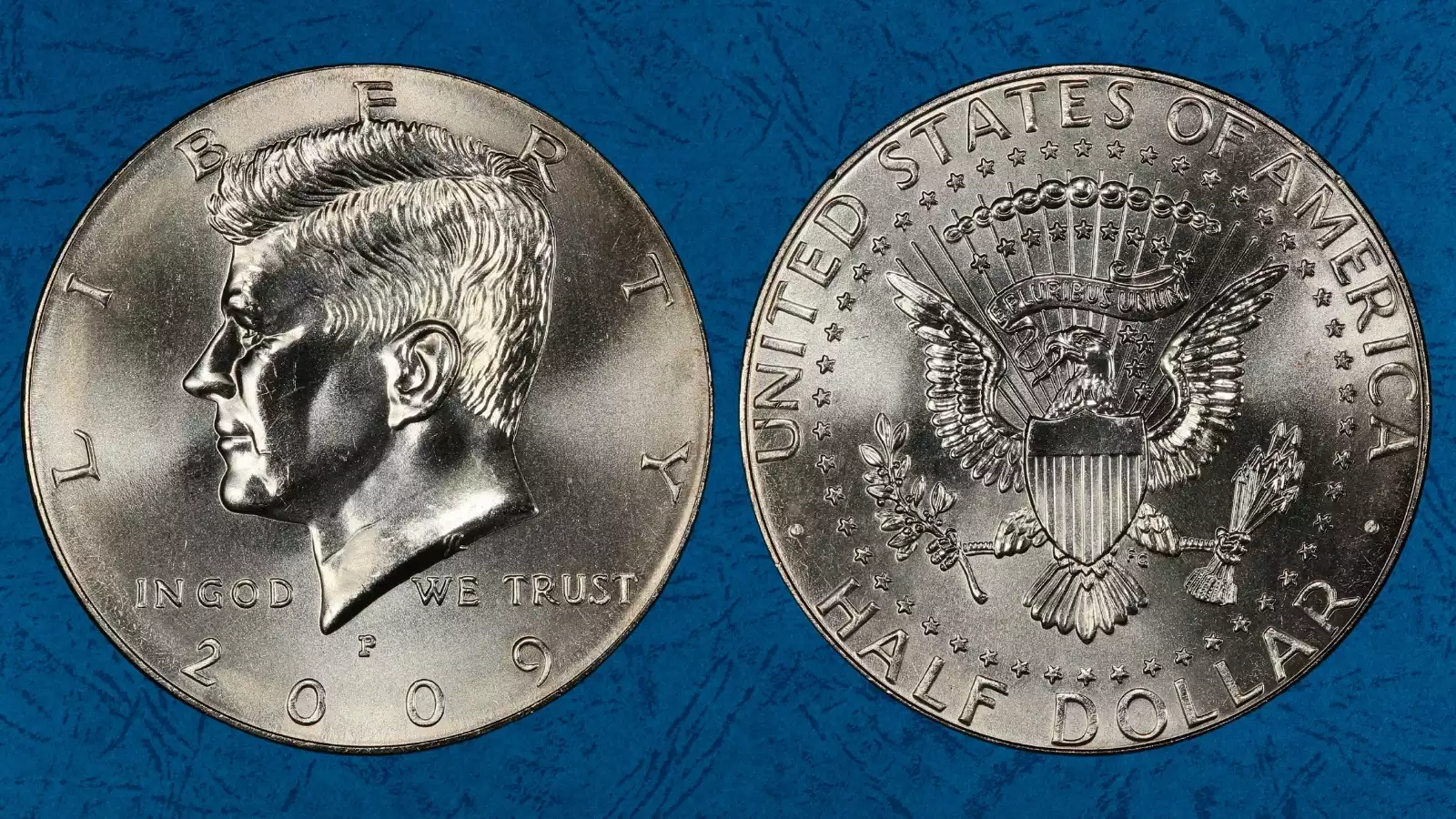
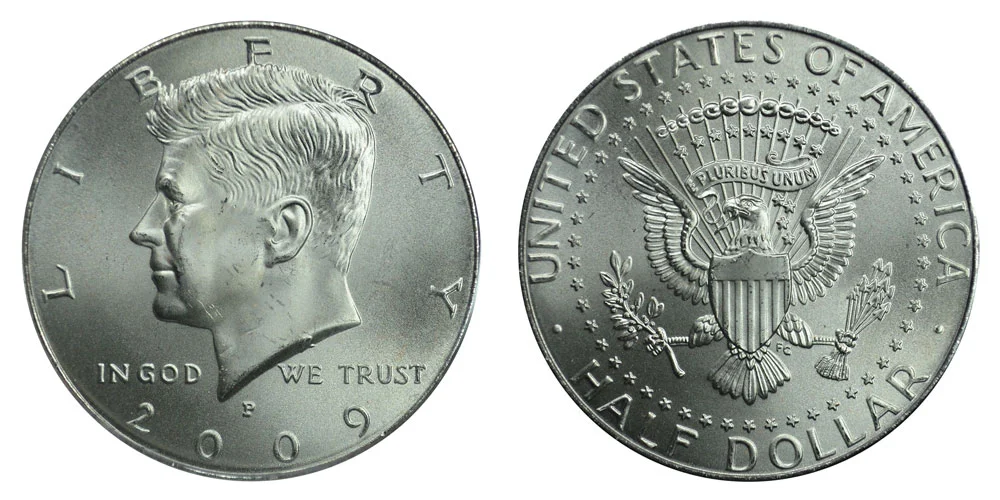
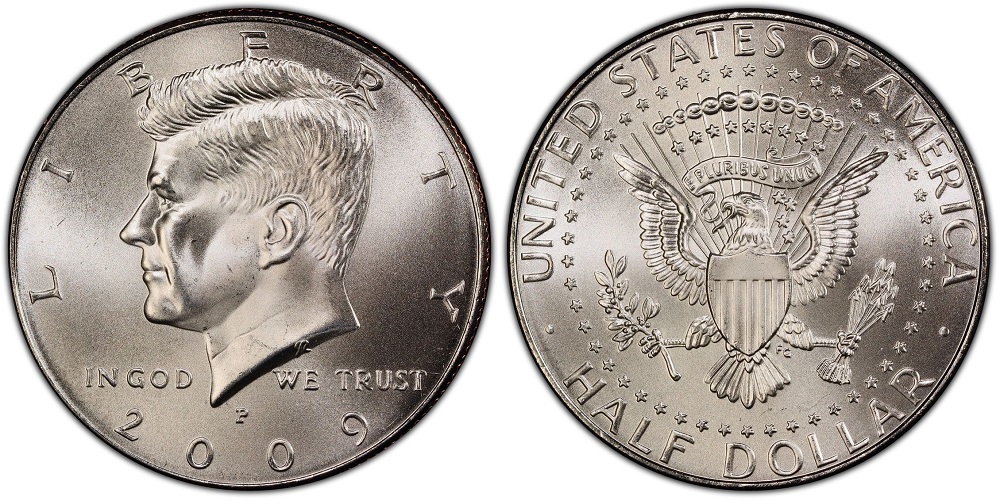
2009 Kennedy half dollar obverse and reverse showing P mint mark and heraldic eagle design
~$1,998 Top auction (2009-P MS68)
3.8M+ Business strikes struck (P+D)
6 Distinct 2009 varieties
MS67+ Grade threshold for scarcity

Free 2009 Half Dollar Value Calculator

Select your coin's mint mark, condition, and any error types to get an instant value estimate.

Step 1: Mint Mark

Step 2: Condition

Step 3: Special Variety / Error

If you're unsure about your coin's mint mark or condition, the 2009 Kennedy Half Dollar Coin Value Checker is a free third-party tool that can help you identify it from photos before using this calculator.

Satin Finish Special Strike Self-Checker

The satin finish SP variety is the most searched 2009 Kennedy half dollar type among collectors. Use this checker to determine if your coin qualifies.

Side-by-side comparison of 2009-P Kennedy half dollar regular business strike vs satin finish SP variety showing surface texture difference

⚪ Regular Business Strike (MS)

  • Bright cartwheel luster that rotates under light
  • Smooth, mirror-like fields between devices
  • Graded MS (Mint State) by PCGS and NGC
  • Mintage: ~1,900,000 per mint (P and D)

🟠 Satin Finish Special Strike (SP)

  • Flat, matte-like surface — no cartwheel luster
  • Finely granular fields under 10× loupe
  • Graded SP (Specimen) by PCGS and NGC
  • Lower mintage: ~784,614 per mint (P and D)

Check all four that apply to your coin:

Want a number, not just a yes/no? Run our calculator to see what your specific 2009 half dollar is actually worth.

Try the Calculator →

What's in This Guide

The Valuable 2009 Kennedy Half Dollar Errors & Varieties (Complete Guide)

The 2009 Kennedy half dollar presents five distinct categories of numismatic interest. Because all business strikes were sold exclusively through U.S. Mint sets and never circulated, condition rarity dominates — but planchet and striking errors add a separate dimension of value. Use the sidebar to jump directly to any variety.

High-Grade Business Strike (MS67–MS68+)

Most Famous $50 – $1,998+
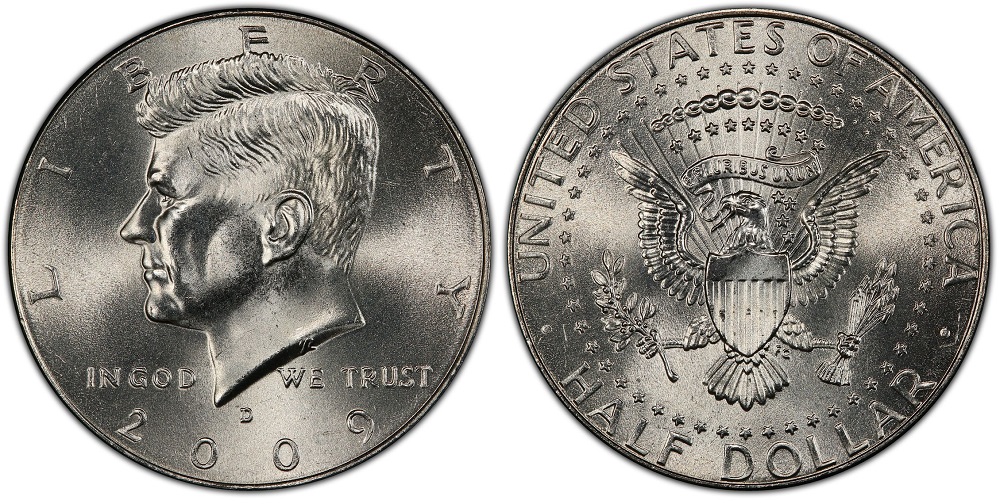
2009-P Kennedy half dollar high-grade MS68 business strike showing exceptional cartwheel luster under lighting

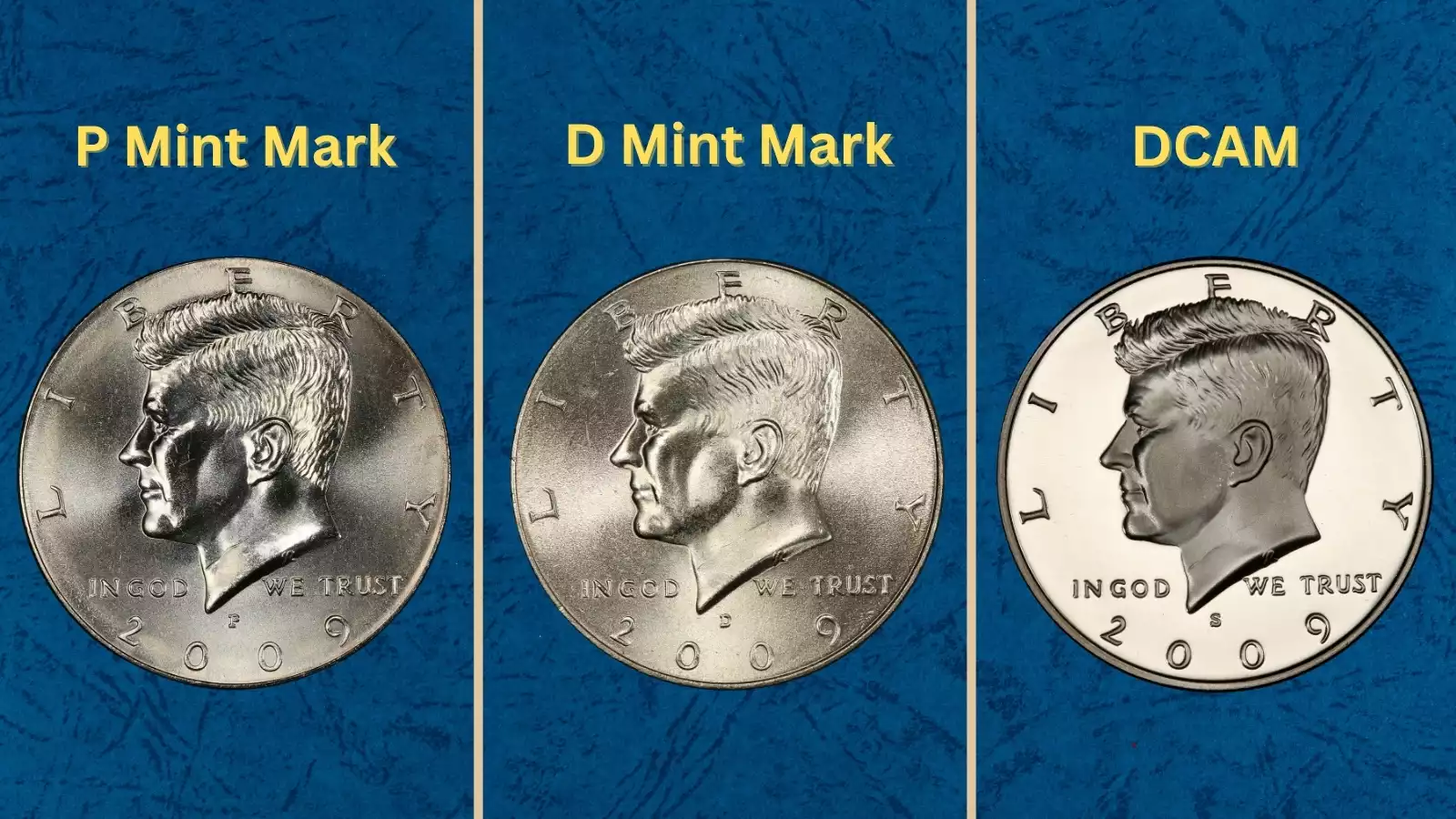
The most searched 2009 Kennedy half dollar "variety" is not a die error but a condition rarity. Because neither the 2009-P nor the 2009-D was released into general commerce, all examples start life in uncirculated condition — yet reaching MS67 or MS68 is far harder than it sounds.

The challenge lies in bag marks and contact abrasions picked up during mint handling and packaging. Modern clad planchets are susceptible to surface scuffs, and the large 30.61mm format of the half dollar gives marks more room to accumulate. PCGS notes that MS67 examples are scarce, while MS68 or higher specimens are very scarce to rare.

A 2009-P MS68 business strike realized approximately $1,998 at auction — a remarkable premium for a coin with a mintage of 1.9 million. The jump from MS66 to MS67 alone can multiply the value several times over, making condition the single most important factor in this series.
How to spot it

Under a 10× loupe, examine the obverse fields around Kennedy's portrait for bag marks. An MS67 coin will have only minor, non-distracting contact marks. An MS68 will appear virtually pristine with full cartwheel luster rotating rim to rim and no visible distractions under 5× magnification.

Mint mark

P (Philadelphia) and D (Denver) only. No business-strike S-mint 2009 halves exist.

Notable

PCGS CoinFacts #407277 (2009-P) confirms MS68 examples are very scarce to rare. The auction record of approximately $1,998 for a single MS68 specimen demonstrates how extreme grade sensitivity governs value in this date and mint combination.

Satin Finish Special Strike (SP65–SP68)

Most Valuable (Type) $5 – $499+
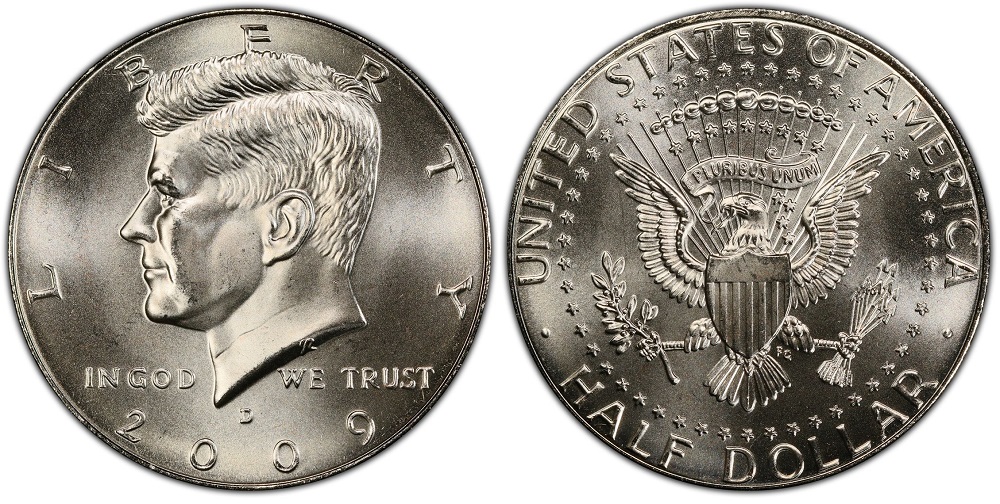
2009-D Kennedy half dollar satin finish SP variety showing distinctive matte granular surface texture compared to regular business strike

The satin finish special strike is the defining variety for 2009 Kennedy half dollar collectors. Struck on specially sandblasted (burnished) planchets, these coins were included exclusively in the 2009 U.S. Mint Uncirculated Coin Set, sold for $27.95 and containing 36 coins. The satin surface was an intentional mint production choice, not an error.

PCGS and NGC recognize these coins with an SP (Specimen) designation rather than the standard MS grade, placing them in a separate certification category. Under magnification, the fields appear finely granular — a distinctive texture that differentiates them from both the cartwheel luster of a regular strike and the deep mirror of a proof. The "D" mint mark variant carries a documented mintage of approximately 784,614, with Philadelphia matching that figure.

An SP62 example of the 2009-D satin finish brought $499 at auction — an extraordinary premium for a coin otherwise worth face value — illustrating how low SP grades can command significant prices when market interest is concentrated. The SP68 Philadelphia example has realized approximately $252, and SP69 brought around $168, showing an inverse grade-to-price pattern driven by scarcity at the very top of the population report.
How to spot it

Tilt the coin under a single light source. A satin finish coin will not show the characteristic rolling cartwheel luster of a business strike. Under a 10× loupe, the fields look finely textured or granular rather than smooth and brilliant. No reflective mirror surface should appear in the fields.

Mint mark

P (Philadelphia) and D (Denver) only. Both carry SP designation; mintage ~784,614 each.

Notable

The 2009-D SP62 realized approximately $499 at a Heritage Auctions sale — an unusual result where a lower SP grade commanded more than higher grades, likely driven by a single aggressive bidder. SP68 examples hold a PCGS population of 471 coins with 23 finer (SP69 or better), per Greysheet data.

Silver Proof PR69–PR70 DCAM (2009-S)

Rarest $15 – $338+
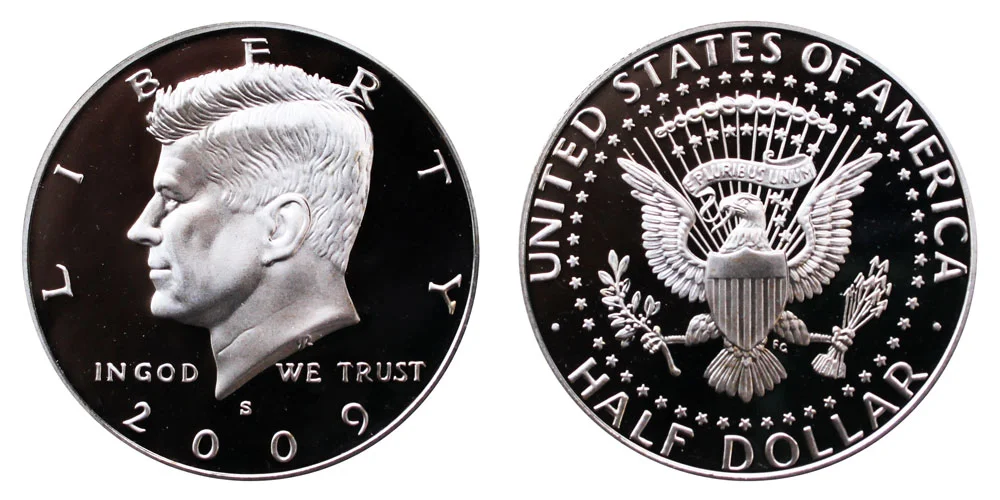
2009-S silver proof Kennedy half dollar PR69 DCAM showing frosted devices and deep mirror fields characteristic of deep cameo proof

The 2009-S silver proof Kennedy half dollar is struck in 90% silver and 10% copper at the San Francisco Mint, giving it both intrinsic metal content and collector premium over its clad counterpart. With a mintage of approximately 697,000 pieces, it is the lowest-production 2009 Kennedy half dollar variety, though still classified as common in rarity rankings.

Deep Cameo (DCAM) examples display the hallmark proof contrast: frosted raised devices (Kennedy's portrait and the heraldic eagle) against highly polished, mirror-like fields. Achieving PR69 DCAM or PR70 DCAM requires that no contact marks interrupt the frosted surfaces — a standard that eliminates a large percentage of the mintage. The PR70 DCAM grade represents a perfect coin by any measurable standard.

The 2009-S Silver PR69 DCAM has brought approximately $338 at auction, while a PR70 example realized around $89 — again showing the counterintuitive pricing where a coin's scarcity at a lower grade can drive prices above the perfect-grade example. The 90% silver composition also provides a metal value floor that the clad proof lacks, giving silver proof holders a double layer of value support.
How to spot it

Check for mirror-like fields reflecting your face clearly under a single overhead light. The S mint mark, visible below Kennedy's neck, confirms San Francisco origin. Genuine silver proofs weigh approximately 12.50 grams (vs. 11.34g for clad) — a simple scale test can confirm the composition without damage.

Mint mark

S (San Francisco) only. Silver proof, 90% Ag / 10% Cu composition. Mintage ~697,000.

Notable

The 2009-S Silver PR69 DCAM has realized approximately $338 at auction, while the PR70 brought around $89 — a pricing inversion driven by extreme population scarcity at PR69 vs. relative accessibility of PR70 for this specific issue. The silver clad proof (also S-mint) is a separate, lower-value coin.

Clipped Planchet Error

Best Kept Secret $25 – $200+
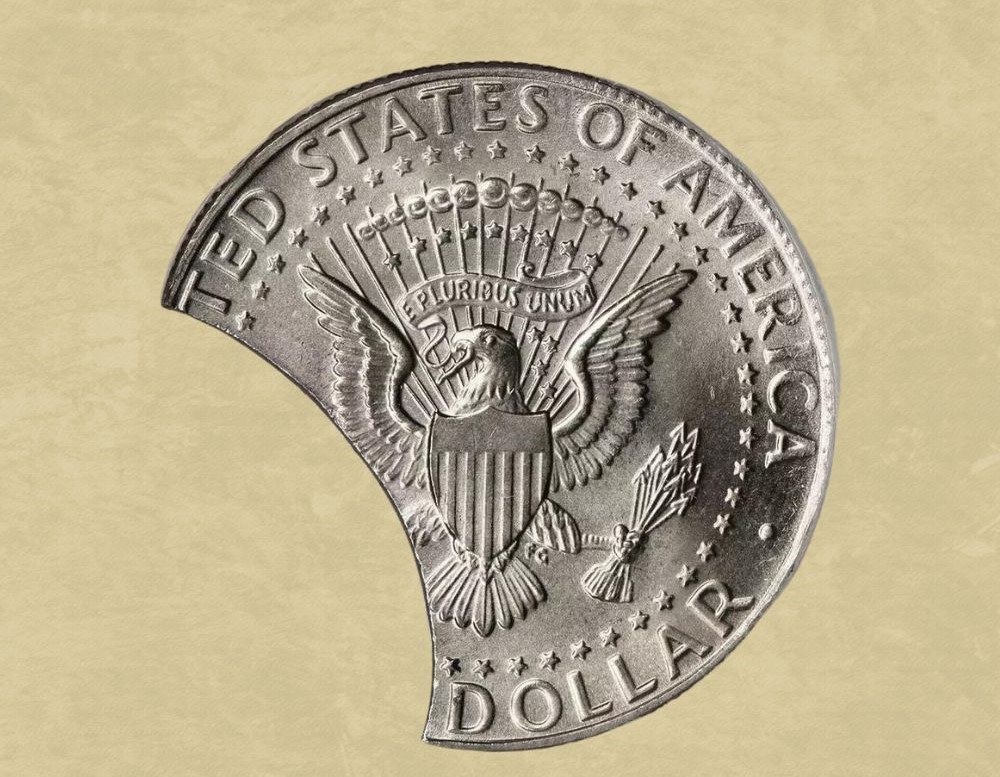
2009 Kennedy half dollar clipped planchet error showing distinctive curved missing section at the coin edge

Clipped planchet errors on the 2009 Kennedy half dollar occur when the strip of copper-nickel clad metal fed into the blanking press is not advanced far enough between punches, causing a new planchet to be cut from an area that overlaps a hole previously punched. The resulting coin lacks a section of its edge — either a curved clip (most common) or a straight clip.

Recognizing a genuine mint-made clip involves checking the Blakesley effect: the area of the coin's design directly opposite the clip will show weakness or incompleteness because metal flowed away from that region during the strike. If the rim, lettering, and devices are uniformly sharp all the way around except at the clipped area, the coin may have been mechanically damaged after minting rather than genuinely clipped.

Values for clipped planchet errors on 2009 Kennedy halves range from about $25 for minor clips in lower grades to $200 or more for dramatic, large clips on high-grade examples. Collectors specifically value clips that involve a significant percentage of the planchet and that clearly exhibit the Blakesley effect. PCGS and NGC will slab genuine clipped planchets with a descriptive designation identifying the clip type and size.
How to spot it

Look for a smooth curved or straight indentation on the coin's edge where planchet metal is missing. Then flip to the opposite side of the coin and look for weakened or missing design detail — this Blakesley effect confirms a genuine mint error vs. post-mint damage. Use calipers to measure the diameter, which will be smaller than the standard 30.61mm.

Mint mark

P (Philadelphia) or D (Denver) business strikes. Clipped planchets can occur at any mint facility.

Notable

Clipped planchet errors are among the most commonly submitted modern Kennedy half dollar errors to PCGS and NGC. Dramatic curved clips greater than 10% of the planchet diameter consistently bring the strongest premiums. Authentication is essential — rim damage from circulation or handling is frequently confused with genuine clips by inexperienced sellers.

Struck-Through Error (Grease, Cloth, or Debris)

Sleeper $20 – $300+
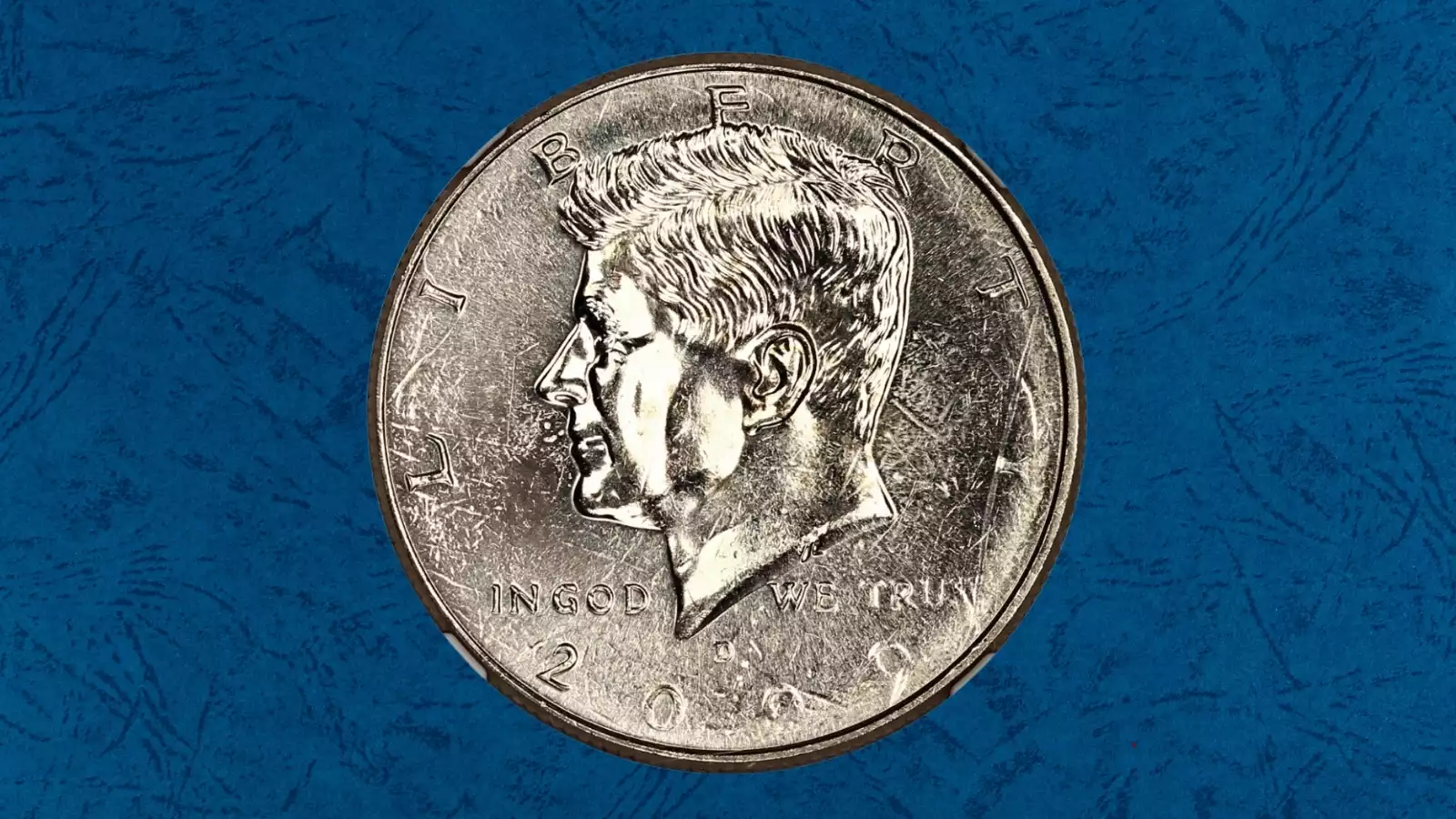
2009 Kennedy half dollar struck-through error showing missing design detail caused by grease-filled die or debris during minting

Struck-through errors on the 2009 Kennedy half dollar occur when foreign material — most commonly die-fill grease, cloth fibers, or metallic debris — is trapped between the die face and the planchet at the moment of strike. The material prevents the die from fully impressing that portion of the design onto the coin, creating a distinctive sunken or missing area on the finished piece.

Grease-filled die struck-throughs typically produce a soft, rounded, featureless area where design detail should appear — most visibly in lettering like "IN GOD WE TRUST" or "LIBERTY," or across the fine detail of Kennedy's hair. More unusual materials such as cloth or wire mesh leave a textured impression of the intervening object in the coin's surface, making these "struck-through with retained material" errors among the most visually dramatic and collectible.

Value is primarily driven by the size and visibility of the struck-through area, the nature of the material involved (unusual foreign matter commands more than common grease), and the coin's grade. A minor grease-fill affecting only a letter or two might bring $20–$50, while a dramatic struck-through covering a major design element and showing a clear impression of the material can exceed $300. PCGS and NGC will detail the type of struck-through on the holder's label.
How to spot it

Under a 10× loupe, look for areas where the design is inexplicably shallow, flat, or missing while the surrounding coin surface looks normal. Grease-fills produce smooth, rounded depressions. Material impressions leave a textured pattern. Post-strike damage (scratches, gouges) has sharp, irregular edges and a distinctly different appearance under magnification.

Mint mark

P (Philadelphia) or D (Denver). Struck-through errors can occur on any business-strike Kennedy half dollar regardless of mint.

Notable

The unusually foreign-material category of struck-throughs — where cloth, wire, or other non-grease items are trapped — consistently generates stronger prices than standard grease-fill varieties. Unusual materials create more collectible errors than common workshop debris, per documented Kennedy half dollar error market patterns. Always submit suspected struck-throughs to PCGS or NGC before selling.

2009 Kennedy Half Dollar Mintage & Survival Data

Group of six 2009 Kennedy half dollar varieties including P and D business strikes, satin finish SP coins, and S-mint proofs
Variety Mint Mintage Strike Type Distribution
2009-P Business Strike Philadelphia ~1,900,000 MS (Business) Mint sets only
2009-D Business Strike Denver ~1,900,000 MS (Business) Mint sets only
2009-P Satin Finish Philadelphia ~784,614 SP (Satin) Uncirculated mint set
2009-D Satin Finish Denver ~784,614 SP (Satin) Uncirculated mint set
2009-S Clad Proof San Francisco ~1,478,000 PR (Proof, Clad) Proof set
2009-S Silver Proof San Francisco ~697,000 PR (Proof, Silver) Silver proof set
Total 2009 Production ~7,544,228 All collector-only distribution

Composition specs — Business & Satin strikes: 75% copper / 25% nickel outer layers on pure copper core; weight 11.30g; diameter 30.61mm; reeded edge (150 reeds). Silver Proof: 90% silver / 10% copper; weight ~12.50g; same diameter. Designer: Gilroy Roberts (obverse) / Frank Gasparro (reverse).

Found one of these varieties in your collection? Run the calculator to see exactly what it's worth today.

Calculate My Coin's Value →

Describe Your 2009 Half Dollar for a Detailed Assessment

Describe what you see on your coin and we'll analyze it for likely variety, condition tier, and estimated value range.

Mention these things if you can

  • Mint mark (P, D, or S)
  • Surface texture (shiny/cartwheel, matte/dull, or mirror/proof)
  • Any visible bag marks or scratches
  • Whether it came in original packaging
  • Any missing or distorted design areas

Also helpful

  • Weight if you have a gram scale
  • Whether edge has any irregularities
  • Color appearance (copper toning?)
  • Any professional slab label details
  • Where you acquired it

2009 Half Dollar Value Chart at a Glance

For a complete in-depth 2009 half dollar identification walkthrough covering every variety and grading nuance, see this detailed step-by-step 2009 Kennedy half dollar reference guide. Values below reflect approximate retail market ranges based on PCGS auction data.

Variety MS63–MS65 / SP65 / PR65 MS66–MS67 / SP67 / PR67 MS68+ / SP68+ / PR69–70
2009-P Business Strike $2 – $8 $15 – $50 $200 – $1,998+
2009-D Business Strike $2 – $8 $15 – $50 $150 – $479+
⭐ 2009-P/D Satin Finish SP $5 – $15 $20 – $60 $89 – $499+
2009-S Clad Proof $4 – $8 $6 – $12 $15 – $50
🔴 2009-S Silver Proof $10 – $20 $15 – $35 $89 – $338+
Clipped / Struck-Through Error $25 – $75 $75 – $150 $150 – $300+

⭐ = Signature variety (Satin Finish SP)  |  🔴 = Rarest by mintage (Silver Proof)

📱 CoinKnow lets you snap a photo of your 2009 half dollar and cross-check the strike type and grade estimate on the go — a coin identifier and value app.

How to Grade Your 2009 Kennedy Half Dollar

Grading strip showing 2009 Kennedy half dollar condition tiers from MS60 bag-marked to MS68 gem quality

MS60–MS62 (Worn Look)

Technically uncirculated but with numerous bag marks, contact abrasions, and possibly weak luster. On a 2009 Kennedy half, these look disappointing — heavy marks across Kennedy's cheek or the eagle's breast feathers push the grade down despite no actual wear. Value: typically $1–$3.

MS63–MS65 (Average Mint State)

The grade range where most 2009 halves fall when pulled from original mint packaging. Luster is present but contact marks are visible to the naked eye. MS65 shows fewer marks with better overall eye appeal. This is the baseline collectible grade for the series. Value: $2–$8 retail.

MS66–MS67 (Choice)

MS66 shows only minor contact marks and strong luster; MS67 approaches gem quality with just one or two minor distractions under 5× magnification. PCGS confirms that MS67 examples are scarce. Collectors building registry sets actively seek this tier. Value: $15–$50 for typical examples.

MS68+ (Gem / Top Pop)

Exceptional coins with virtually no visible marks under 5× magnification, full blazing cartwheel luster, and a sharp, complete strike. PCGS notes these are very scarce to rare for the 2009-P. A single MS68 example has brought approximately $1,998. The difference from MS67 is subtle but financially enormous.

💡 Pro Tip — Strike and Surface Designation: For 2009 Kennedy halves, the SP (Specimen) designation for satin finish coins is just as important as the numeric grade. An SP68 satin finish is a fundamentally different coin from an MS68 business strike — different surface preparation, different population, different price curve. Always check whether your coin's PCGS or NGC holder reads MS or SP before comparing to price guides.

🔎 CoinKnow helps you match your coin's surface preservation to certified examples — scan your coin and compare your result against graded population data — a coin identifier and value app.

Where to Sell Your Valuable 2009 Kennedy Half Dollar

🏛️ Heritage Auctions

The premier venue for high-grade 2009 Kennedy halves. If your coin grades MS67 or higher, or is an SP68 satin finish, Heritage reaches the deepest pool of competitive bidders. Their Kennedy half dollar specialist team will evaluate your coin accurately. Expect 15–20% seller's fees but the best realized prices for top-tier examples.

🛒 eBay

The largest marketplace for typical MS63–MS66 2009 halves and satin finish examples. Browse recent sold prices for 2009-P Kennedy half dollars to calibrate your asking price. Fixed-price listings work well for common grades; auction format suits mid-range examples where competition drives results. Always use padded coin mailers for shipping.

🏪 Local Coin Shop

Best for quick, no-hassle cash transactions on circulated or average-grade examples. Dealers will typically offer 50–70% of retail for common grades. Bring multiple coins if you have them — dealers often pay better per coin when buying in quantity. A local shop is also a good first stop for a free verbal opinion on grade before committing to a formal PCGS/NGC submission.

💬 Reddit r/Coins4Sale

A growing marketplace for direct collector-to-collector sales, ideal for mid-range 2009 halves where you want to avoid eBay fees. No buyer's premium — you keep the full sale price. Posting clear photos and a realistic asking price based on PCGS auction comparables gets fast responses. Best for MS65–MS67 examples and complete 2009 satin finish pairs.

💡 Get It Graded First: For any 2009 half dollar you believe grades MS67 or higher, or any SP68+ satin finish example, professional grading by PCGS or NGC before selling can substantially increase realized prices. The added credibility of a certified holder justifies submission fees of $30–$50 for coins in this value tier. For typical MS63–MS65 examples, direct sale is more economical.

Frequently Asked Questions

How much is a 2009 half dollar worth?

Most 2009 Kennedy half dollars in typical MS63–MS65 condition are worth $2–$10. The 2009-P and 2009-D business strikes were never released for circulation and were sold only through U.S. Mint sets. In top grades like MS68, values can reach approximately $1,998. Satin finish special strikes from mint sets generally trade between $3–$25 in SP65–SP67, while silver proof versions in PR69 DCAM bring around $15–$40.

Were 2009 half dollars released into circulation?

No. The 2009-P and 2009-D Kennedy half dollars were not released into general circulation. The U.S. Mint sold them only to collectors through the annual Uncirculated Mint Set, priced at $27.95. This has been the case since 2002, when half dollars were removed from circulation distribution. The San Francisco Mint produced only proof versions for the 2009-S.

What is the 2009 satin finish half dollar?

The satin finish variety was struck on specially sandblasted (burnished) planchets and included in the 2009 U.S. Mint Uncirculated Coin Set. These coins carry an SP (Specimen) designation from PCGS and NGC rather than the standard MS grade. The 2009-P and 2009-D satin finish halves each had a mintage of approximately 784,614, making them less common than the regular business strikes of 1.9 million each.

What is the mintage for the 2009 Kennedy half dollar?

The 2009-P business strike had a mintage of approximately 1,900,000 coins, matching the 2009-D at roughly 1,900,000. The satin finish SP versions were struck in lower quantities — approximately 784,614 each for Philadelphia and Denver. The San Francisco proof had a mintage near 1,478,000 in clad format, while the 90% silver proof reached around 697,000 pieces.

What makes a 2009 half dollar valuable?

Condition is the primary driver of value for 2009 Kennedy halves. Since all examples were sold directly from the mint and never circulated, the baseline grade is MS63–MS65. Exceptional specimens grading MS67 are considered scarce, and MS68 or higher are very rare. Satin finish examples with SP68 or better grades also command premiums. Error coins such as clipped planchets or dramatic struck-through errors add further value depending on severity and grade.

How do I tell a satin finish 2009 half dollar from a regular strike?

The satin finish 2009 Kennedy half dollar has a distinctive matte-like, non-reflective surface texture compared to the cartwheel luster of a regular business strike. Under a 10× loupe, the fields appear finely granular rather than smooth and shiny. Satin finish coins were included in the 2009 Uncirculated Mint Set in a sealed case; finding the original packaging is the easiest confirmation. PCGS and NGC assign these an SP (Specimen) grade rather than MS.

Is the 2009 silver proof half dollar worth more?

Yes. The 2009-S silver proof Kennedy half dollar is struck in 90% silver and 10% copper, giving it an intrinsic metal value above the clad versions. In PR69 Deep Cameo, silver proof examples typically trade in the $15–$40 range. A PR70 DCAM example has brought approximately $89 at auction. The clad proof (also 2009-S) is less valuable due to its copper-nickel composition, typically worth $6–$15 in PR69 DCAM.

Where is the mint mark on a 2009 Kennedy half dollar?

The mint mark on the 2009 Kennedy half dollar is located on the obverse (front) of the coin, just below and to the right of Kennedy's neck truncation. A P indicates Philadelphia, D indicates Denver, and S indicates San Francisco. On 2009 coins there is no mint mark on the business strikes from Philadelphia — the P was added only on some issues. Check directly under the portrait's bust line.

What errors exist on the 2009 Kennedy half dollar?

The 2009 Kennedy half dollar does not have any widely recognized major hub-doubled die varieties with their own PCGS numbers. However, planchet errors such as clipped planchets (straight or curved clips), struck-through errors (grease-filled dies, cloth, or debris), and off-center strikes have been documented. Values depend heavily on the size and visibility of the error. Dramatic examples in high grades can bring significant premiums over standard coins.

Should I get my 2009 half dollar graded by PCGS or NGC?

Professional grading is worthwhile only if the coin grades MS67 or higher for business strikes, SP67 or higher for satin finish, or PR69 DCAM and above for proofs. At those grades, the added credibility of a slab from PCGS or NGC can meaningfully increase sale prices. For typical MS63–MS66 examples, the cost of submission ($30–$50+) usually exceeds the added value the holder provides. Error coins should almost always be submitted for authentication.

Ready to find out what your 2009 half dollar is really worth?

Run the Free Value Calculator →